Puerto Rico
Labor Market
Overview What this dashboard measures
What you are looking at: a monthly summary of Puerto Rico's labor market conditions, combining 40 economic indicators into a single index using a dynamic factor model.
Methodology: The PR-LMCI follows the Chicago Fed Labor Market Conditions Index (Brave and Cole, 2014). It extracts the first principal component from a standardized panel of 40 indicators using EM-PCA to handle missing data.
Three outputs:
- PR-LMCI Level: the level of labor market conditions (0 = historical average).
- PR-LMCI Momentum: month-over-month change in the PR-LMCI level.
- Diffusion Index: % of indicators improving (above 50% = broad-based).
Indicator categories: the curated panel spans the groups below. Indicators lacking sufficient history are dropped each release, leaving 40 series in the latest index.
- Non-farm payroll employment by NAICS sector
- Labor force, employment, unemployment, participation rate
- Job flows: BED gross gains, gross losses, net change
- Unemployment insurance claims: initial and continued
- Tourism: non-resident registrations, hotel occupancy, SJU airport passengers
- Construction: cement production, building permits, foreclosures
- Trade: exports, imports, cargo throughput
- Consumer demand: auto sales, gas consumption, vehicle registrations
- Fiscal: income tax, excise taxes, motor vehicle tax
- Energy: industrial and residential electric power consumption
- Other: total bankruptcies, PR Economic Activity Index
Data sources:
- Puerto Rico Planning Board (Junta de Planificacion) — monthly economic indicators
- PR Dept. of Labor, LMI Division — Business Employment Dynamics (job flows)
- US Dept. of Labor, ETA — Weekly unemployment insurance claims
- PR Dept. of Economic Development (DDEC) — Auto sales
Current conditions July 2026 (preliminary)
Preliminary. The July 2026 reading is based on partial data — 70% of indicators reported and will be revised as additional indicators are released.
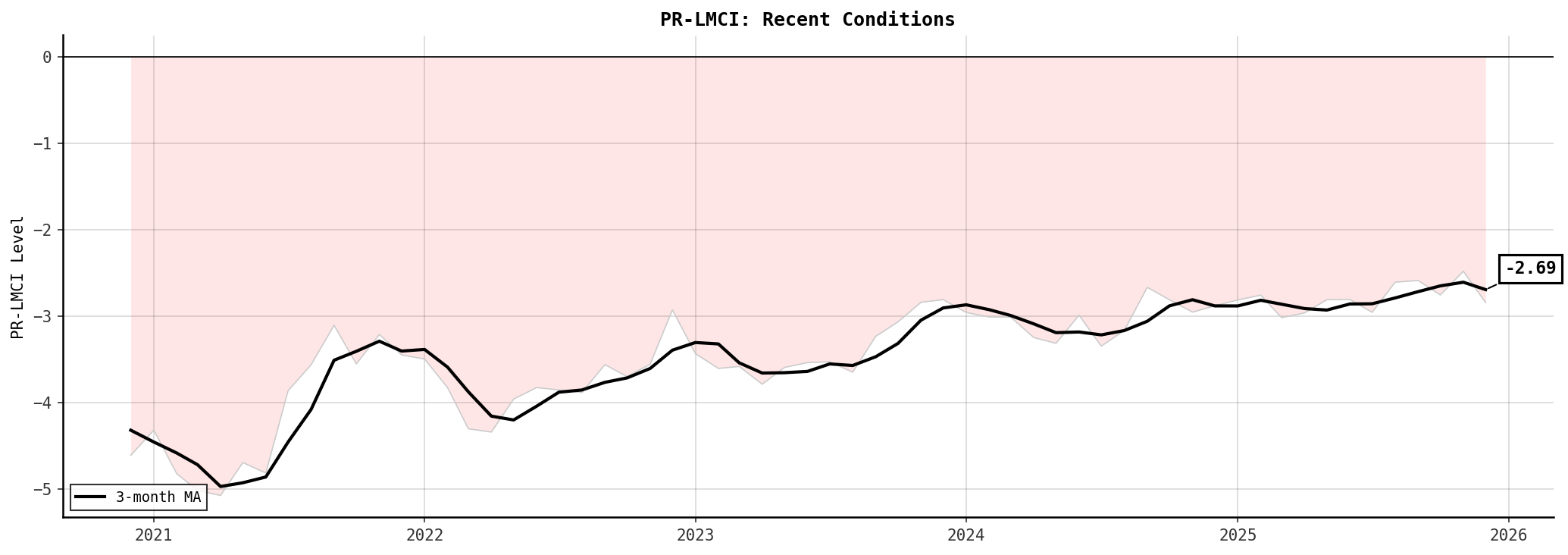
Recent trajectory
Release comparison
| Latest (July 2026) |
Previous Month (Jun 2026) |
Year Ago (Jul 2025) |
|
|---|---|---|---|
| PR-LMCI Level | -2.88 | -2.94 | -2.90 |
| PR-LMCI Momentum | +0.06 | +0.03 | -0.09 |
| Diffusion Index | 50.8% | 44.2% | 46.7% |
| Prob. Improving | 57% | -- | |
Labor Flows (BED) Job flows • as of Dec 2025
| Latest (Dec 2025) |
Previous (Nov 2025) |
Year Ago (Dec 2024) |
|
|---|---|---|---|
| Hiring Rate | 1.19% | 1.27% | 1.16% |
| Separations Rate | 1.39% | 1.44% | 1.45% |
| Net Flow | -0.20 pp | -0.17 pp | -0.29 pp |
Note. Business Employment Dynamics (BED) job flows are published quarterly by the PR Dept. of Labor with a lag. The most recent available quarter is Dec 2025, so these rows trail the July 2026 index reading and will advance when the next BED release is posted.
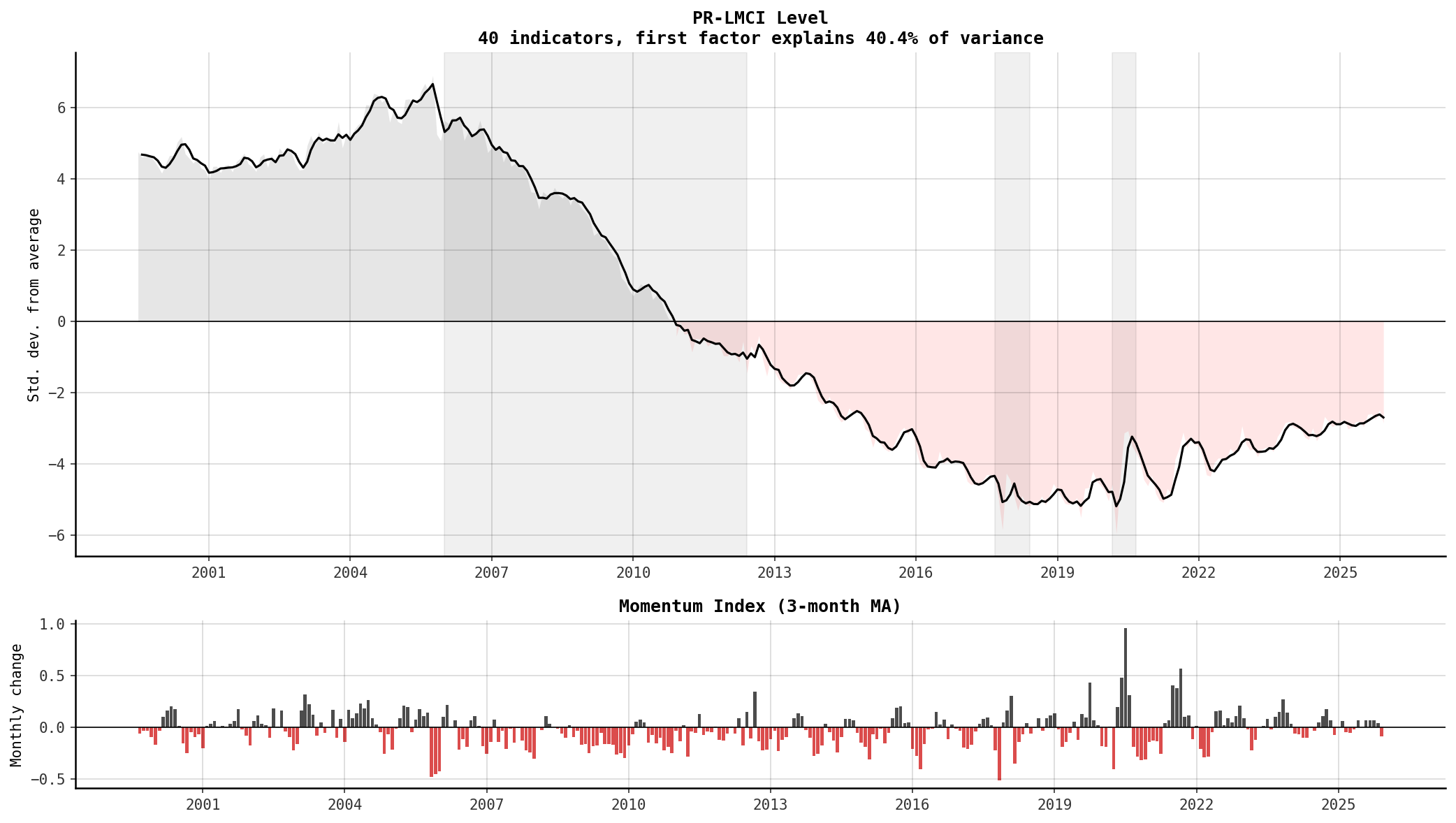
The Puerto Rico Labor Market Conditions Index (PR-LMCI) was little changed at -2.88 in July 2026, indicating that labor market conditions are below average. The PR-LMCI Momentum registered +0.06, suggesting conditions are improving. The index has been below its historical average for 186 consecutive months (see PR-LMCI Level below). The July 2026 reading is preliminary (70% of indicators reported) and will be revised as additional data arrive.
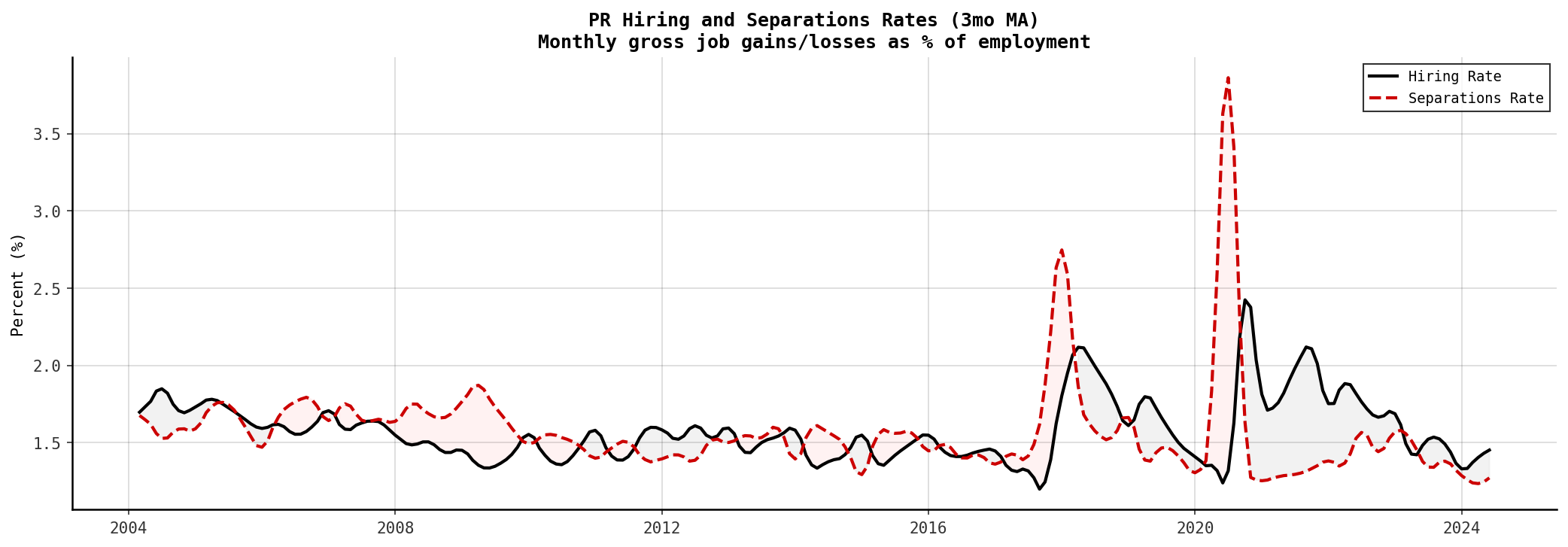
The hiring rate, which measures gross job gains as a share of employment, stood at 1.19% in December 2025, below its 12-month average of 1.53%. The separations rate registered 1.39%, with separations exceeding hiring. The net flow rate of -0.20 percentage points suggests net employment contraction (see Hiring and Separations Rates below). These job-flow figures come from the Business Employment Dynamics series, which is published quarterly with a lag; December 2025 is the most recent period available, so they trail the July 2026 index reading above.
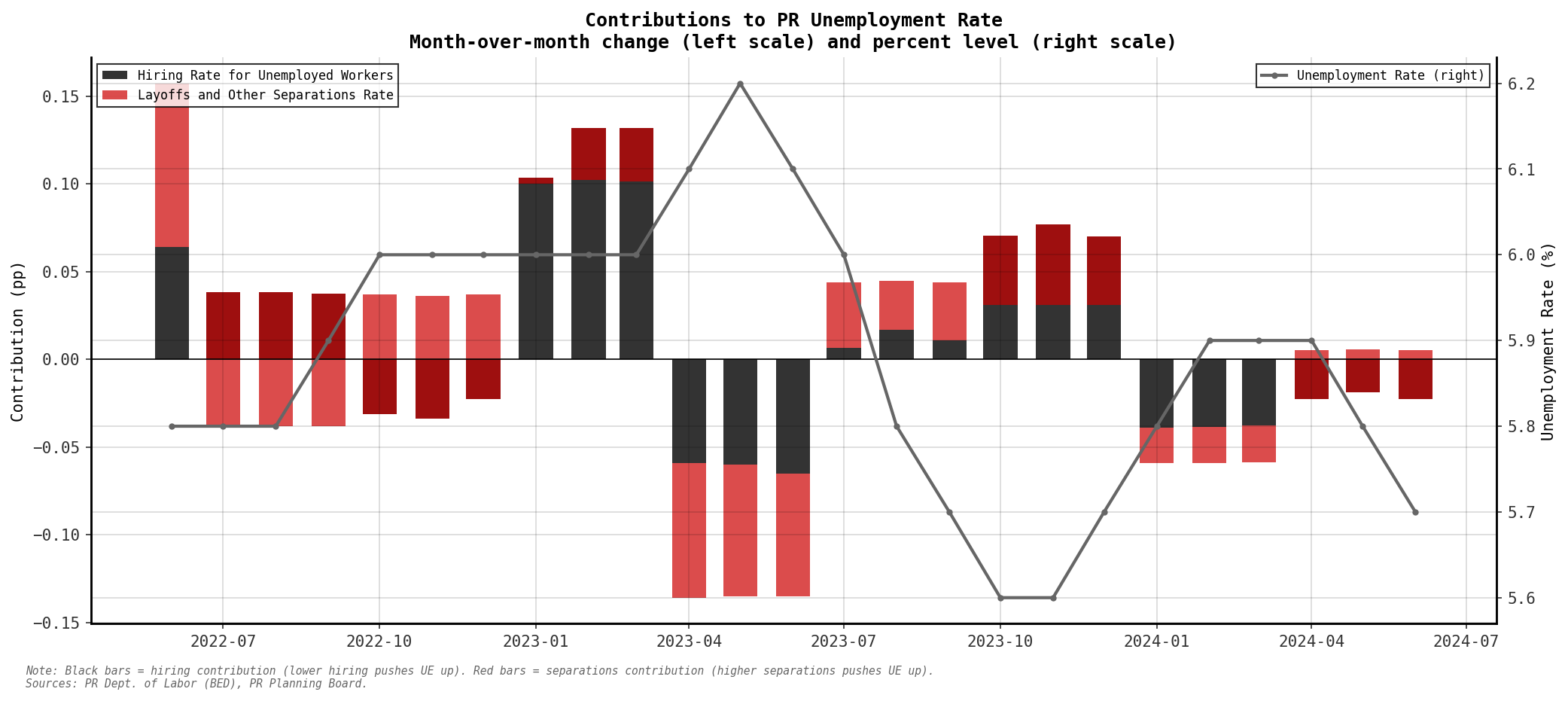
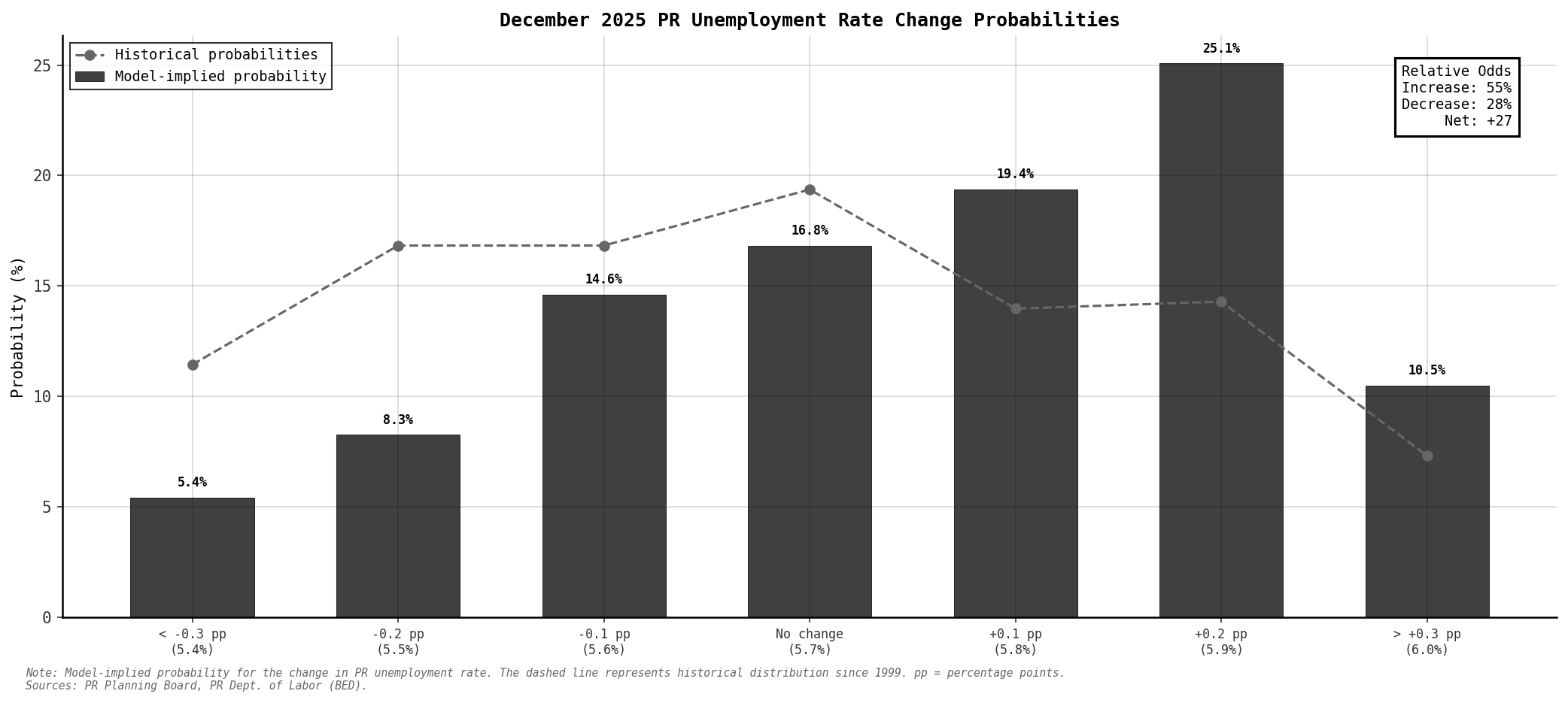
The unemployment rate rose to 6.0% in July 2026. Over the three months through December 2025, changes in the hiring rate were the dominant flow-based driver of unemployment rate movements (see Contributions to Unemployment Rate below). The model-implied distribution for the next-month unemployment-rate change puts 28% odds on a decrease, 17% on no change, and 55% on an increase (see Unemployment Rate Change Probabilities below). This characterizes the balance of risks rather than a point forecast; out of sample the distribution does not improve on a no-change baseline for the direction of the next move.
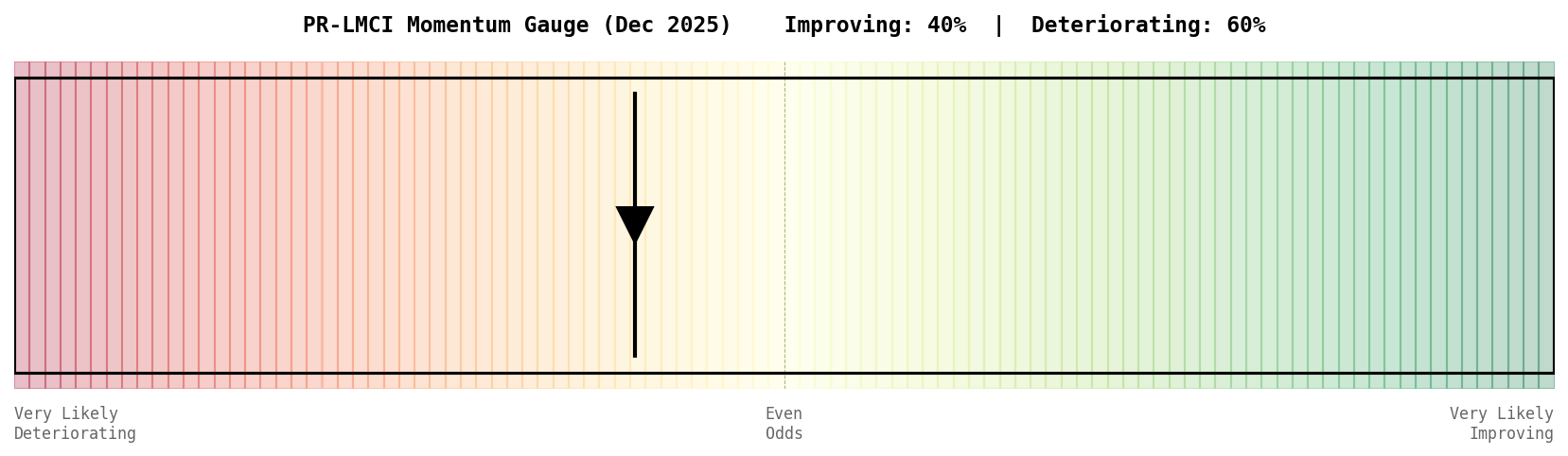
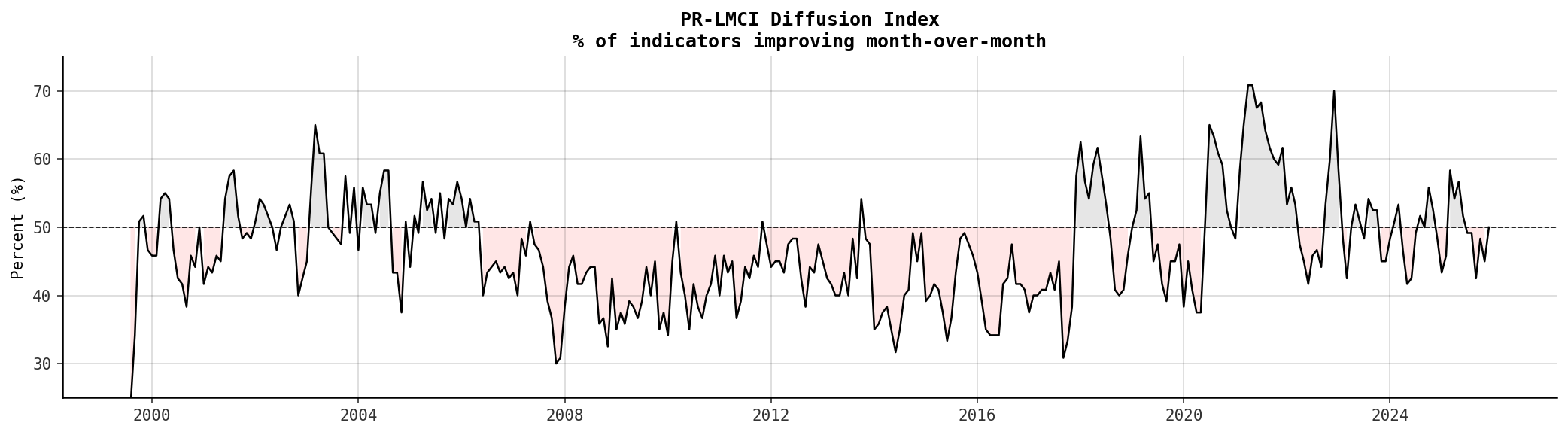
The diffusion index, which measures the share of indicators improving month-over-month, stood at 50.8%, indicating mixed conditions (see Diffusion Index below). The Momentum Gauge suggests a 57% probability that conditions will improve in the coming month, versus 43% for deterioration.
The current reading places PR labor market conditions at the 40th percentile of all observations since 1999, below the median of historical readings. For comparison, the average PR-LMCI was -3.66 in the pre-Maria period (2015-2017), -4.79 in the post-Maria/pre-COVID period, and -3.30 since mid-2021. The index is currently most influenced by economic activity index, cement production, government - sa (thousands of persons (sa)) (pro-cyclical) and education and health services, professional and business services, excise taxes (counter-cyclical). (See Recent Conditions below.)
Hiring and Separations Rates Inflow and outflow rates of employment
What these measure: The hiring rate (black solid) measures gross job gains as a share of total employment. The separations rate (red dashed) measures gross job losses. When hiring exceeds separations, employment is expanding. The shaded area shows the gap.
Data source: PR Business Employment Dynamics (quarterly, interpolated to monthly).
Data through Dec 2025. BED job flows are quarterly and lag the monthly index; this chart advances when the next quarter is released.
Contributions to Unemployment Rate Hiring vs separations decomposition
How to read: Black bars show the contribution of hiring (lower hiring pushes UE up). Red bars show the contribution of separations (higher separations pushes UE up). The line on the right axis tracks the actual unemployment rate level.
Data through Dec 2025. BED job flows are quarterly and lag the monthly index; this chart advances when the next quarter is released.
Unemployment Rate Change Probabilities Unconditional distribution • balance of risks
How to read: Black bars show a probability distribution for next month's unemployment-rate change, implied by the historical relationship between labor-market flows and the unemployment rate. The dashed line is the unconditional historical distribution of monthly changes since 1999. Read this as a characterization of the balance of risks — the spread of outcomes plausible next month — not as a point forecast.
Out-of-sample caveat. In a walk-forward backtest this flow-based distribution does not beat a random-walk (assume-no-change) baseline at predicting the level or direction of the next unemployment-rate change. Its value is in sizing the range of outcomes: the ±1σ band's realized coverage (~71%) is close to its nominal 68%. See Validation & robustness.
Momentum Gauge Probability of improvement vs deterioration
How to read: The marker shows the probability that labor market conditions improve next month, based on the historical distribution of month-to-month momentum. When the marker is right of center, improvement is more likely than deterioration. Like the unemployment-rate distribution above, treat this as a balance-of-risks read, not a validated point forecast.
PR-LMCI Level Level of labor market conditions over time
How to read: Values above zero indicate above-average conditions; below zero indicates below-average. The 3-month moving average smooths monthly noise. Grey bands mark the 2006-2012 recession, Hurricane Maria, and COVID-19.
Diffusion Index Breadth of improvement across indicators
How to read: The diffusion index measures what fraction of the 40 input indicators improved month-over-month. Values above 50% indicate that more indicators are improving than deteriorating (broad-based improvement). Currently at 50.8%.
Methodology Technical note
The PR-LMCI adapts the methodology of the Chicago Fed Labor Market Indicators (Brave, Butters, and Kelley, 2019) to Puerto Rico using locally available data.
Factor model. The PR-LMCI level is the first principal component extracted from a standardized panel of 40 monthly indicators using Expectation-Maximization PCA (EM-PCA), which handles missing observations and ragged edges common in Puerto Rico data releases. The index is normalized so that zero represents the historical average. The PR-LMCI Momentum is the first difference of the level.
Diffusion index. The share of the 40 input indicators that improved month-over-month, smoothed with a 3-month moving average. Values above 50% indicate broad-based improvement.
Labor flows. Hiring and separations rates are derived from the PR Business Employment Dynamics (BED) program, which reports quarterly gross job gains and losses. Quarterly flows are converted to monthly rates by dividing by 3, then expressed as a percentage of total non-farm employment. The contributions to unemployment rate change decompose month-over-month UE changes into the portions attributable to changes in the hiring rate (downward pressure when hiring increases) and the separations rate (upward pressure when separations increase).
Probability distributions, not point forecasts. The unemployment-rate change distribution maps recent labor-market flows onto the historical distribution of monthly unemployment-rate changes since 1999; the momentum gauge summarizes the net balance of improvement vs. deterioration risk from the recent PR-LMCI trajectory. Both are presented as unconditional distributions that characterize the balance of risks. Out of sample they do not improve on a naive no-change baseline for the point or direction of the next move (see Validation & robustness), so they should not be read as directional forecasts with an edge.
Key differences from the Chicago Fed. The Chicago Fed uses Current Population Survey (CPS) microdata and real-time private sector data (ADP, Indeed, Google Trends, Morning Consult) combined via partial least squares (PLS). These sources are not available for Puerto Rico. Instead, the PR-LMCI uses a curated panel of 40 indicators drawn from the PR Planning Board, BED job flows, DOL unemployment insurance claims, and DDEC auto sales as inputs to a standard PCA factor model. Indicators were selected through a multi-evaluator consensus process prioritizing non-redundancy, category balance, and minimum sample size.
Validation & robustness. The index is put through a standard battery of robustness checks, summarized below and re-verified whenever the panel of indicators changes.
- Strong common factor. The first principal component explains ~40% of the standardized panel's variance — roughly 16× the ~2.5% a no-structure panel of this size would give — and the first two components together ~62%. The indicators share a strong common signal.
- No single series drives it. Dropping any one indicator and re-estimating leaves the index essentially unchanged (leave-one-out correlation ≥ 0.997).
- Redundancy is harmless. Collapsing near-duplicate series to one representative per concept reproduces the index almost exactly (correlation ~1.00), so the level is not an artifact of over-weighting any one category.
- Imputation is stable; the latest month is soft. EM imputation and simple mean-fill produce nearly identical histories (correlation ~0.998). But the most recent month is a ragged edge — often only ~70% of series have reported — so it is published as preliminary and can move on the order of ~0.5 index points as late data arrive.
- The level is robust; the driver ranking is era-specific. Factor loadings reshuffle between the pre-2016 and post-2016 samples (loadings correlation ~0.2). The overall level and momentum are stable, but the ranked list of top drivers should be read within the current era, not as a fixed structural ordering.
- The unemployment-rate distribution earns its bands, not an edge. In an expanding-window, walk-forward backtest the flow-based UR forecast does not beat a random walk on the level or direction of the next change; its ±1σ interval coverage (~71%) is close to the nominal 68%. It is therefore presented as an unconditional distribution.
- Composition is audited. Every intended indicator is reconciled against what actually enters the model, and the full indicator universe is periodically re-scanned for overlooked series. The current panel is employment-heavy by data availability, and no high-coverage, non-redundant series is being missed.
References:
- Brave, S. A., R. A. Butters, and D. Kelley (2019), "A New 'Big Data' Index of U.S. Economic Activity," Economic Perspectives, Federal Reserve Bank of Chicago, No. 1.
- Brave, S. A. and J. R. A. Cole (2014), "Labor Market Conditions Index: LMCI Methodology," Chicago Fed, unpublished.
- Shimer, R. (2012), "Reassessing the Ins and Outs of Unemployment," Review of Economic Dynamics, 15(2), pp. 127-148.
Data Download the full time series
The PR-LMCI data is available for download in CSV format.
- PR-LMCI index — activity, momentum, diffusion (monthly)